Thursday, April 5, 2018

Blue Moon Rising

On 31 March we saw Blue moon. It was a rare that one calendar year saw two months of two full moons which was January and March. Next will be happening in 2037. I tried to take some pics of its rising from Sirohi, Rajasthan. Its a small town located down to the one of the mountain in Aravali range. This small mountain named as Mater Mata (named after a local godess) located to the east of town. So, its very beautifull site to watch celestial objects rising over it. This blue moon I captured some of pictures of rising moon. I am still understanding function of DSLR. I hope you will like it.


 As I said, earlier in my article on this blog Blue moon is not actually blue in color. It appear just as normal moon. The term actually meant to indiacate an extra full moon in a astronomical season or in a month.

Saturday, March 31, 2018

Blue Moon and how we see it

On 31 March we are witnessing Blue Moon. You might have encounter with term Blue Moon in news media. In media, news usually appear with Blue color moon picture and says 'this month we are going to see blue moon'. Many people wonders  how moon will be in blue color? it must be a great sight in sky seeing blue color moon. But, Blue moon is nothing to do with color. It is a name of moon which occurs as a extra full moon in a month or in a astronomical season.
Blue moon is not actualy blue in color

In every cultures moon has different names. In India too have different names according to seasons and festivals. In western culture, they also given name to full moon according to seasons. Like, October month moon is called as Hunters Moon because peoples who lives at northern hemisphere start collecting food and meat for coming winter. December moon is called as cold moon and March moon is called as worm moon. These names are not uniformly used in entire western culture. These also change from tribe to tribe or culture to culture. 

Every culture or tribe made their own calender based on sun or moon to maintain their yearly activities. Every season like spring, summer, fall and winter usually see three full moons. These seasons happens due to sun motion in Earth's sky. Sun takes 365.24 days to complete one cycle in Earth's sky which we called a year. (Earth move around the sun in space and from earth we see sun is moving in sky. Its a relative motion we observe.). But, to complete one cycle in sky moon takes 29.5 days. When sun colpletes its one cycle in 365.24 days, by the time moon complets 12.37 cycles. So, each calender year get around 11 extra days from moon cycle. Due to accumulation of these days from lunar cycle we see extra full moon in a season after two or two and half calendar year. This extra full moon is called as Blue moon. Indian calender make adjustment in calendar to stay with seasons by inserting Adhik Maas after two and half year. (Incorporating extra moon cycle vary with different calendars.)

Another way to describe Blue moon is, a second full moon in same calendar month. This calendar year 2018 has two Blue moon month one was January and second is March. This is rare, next calendar year with two Blue moon will be 2037. But, sinlge Blue moon month happenes every two and half year. Next, Blue moon will appear in Octber 2020. 

Astronomical events and news media

When people hear or read about blue moon, they usually think that moon will appear in blue color. Because, the way news media present this event. In age of Information and technology news media has become most unscientific mode of information. Many times not enough research happens aroud topic and to just grab attention of public, news are presented in dramatic way which leads to misconception. News Media also wrongly present other natural or astronomical events like eclipses, appearance of comets or when mars comes near to earth in its orbit. For example, news about eclipse will show less about science behind it and more about effect of eclipse on someones zodiac signs and how it will doom person's fate. This leads people and society towards superstions. I think every time nature gives us opportunity to become more rational and logical, we misuse it and becomes more irrational. News media has played very important role for social awareness time to time. Now, in this time it is very much required a role of scientific and rational media to create scientific attitude in society. 


Saturday, March 17, 2018

Why we cant see Stars in day time?

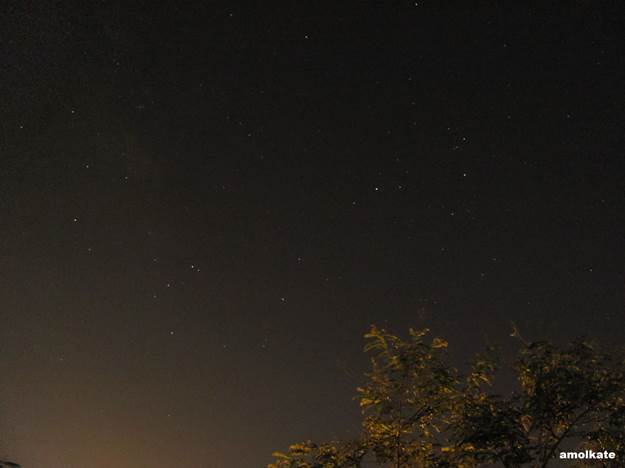
Night sky with full of shining stars is always spectacular site to view from the country side. If moon is not present in the night then the site becomes fascinating. We cant see this view during day time. After sun set also we cant see stars suddenly appear in sky. It takes sometime for coming them out entirely until the sky becomes dark after sunlight totally goes off. Question that why we cant see stars in day time wonders most us. Whats the reason behind it?
Straight answer we get for this is due to sun's strong light we simply cant see them. But, what exactly happens when sun comes in our sky and how it limits us from seeing stars. Our Earth's atmosphere plays key part in this phenomenon. When sun comes in our sky sun's light is scattered by the atmospheric gases and dust particles. Due to this scattering earth's sky illuminates. Due to this illumination day time sky outshine other stars.

Night time sky with full of stars

We have seen that on Full moon night we do not observe much stars due to moon light. Sky near the moon is much brighter than rest of sky so in this area we see very very few stars. Same during dawn and dusk also we can see very few stars. We can understand this phenomenon by recalling our experiences, what happens if we lit small bulb in front of much brighter street lamp? in this case we could hardly see light coming from small bulb. This can be observe during night driving, if a small bike is riding ahead truck we could hardly notice bike in front of trucks brighter light. For our eyes it is difficult to sense small intensity of light in front of big intensity light source. 


Then how much brighter object we can see in our day time sky?
Many times astronomers looks distance space objects like galaxies which having magnitude more than 14. In such conditions astronomers looks for the very dark sky means having magnitude more than this object. As atmosphere scatters light due to dust and gas particle it behave as light or illuminated object. If sky appear more brighter then such faint object will disappear. Object visibility in the sky depend on how much object is bright and how much sky is bright or dark. Sky conditions varies during dawn or dusk, presence of sun  or moon in sky and nowadays light pollution from greater cities affects sky views.
Brightness of celestial objects measures in magnitude. There are two types of magnitudes astronomers use, apparent and absolute. Here we will discuss only about apparent magnitude scale. If we look at the night sky, we can see stars with different brightness. Some stars are much brighter on the other hand some are so faint that we hardly notice them. Astronomers in ancient time made a comparative scale to measure intensities of stars. They took one star for a reference which they denoted as 1 magnitude star and with the caparison to this they measure fainter stars and brighter stars. If star appear 2.5 times fainter then it will be 2 magnitude star. If it is 2.5 x 2.5 times fainter then it will be 3rd magnitude star. so, 3rd magnitude star will be 6.25 fainter than 1 magnitude star. Human eyes could observe 6 magnitude star which is 100 times fainter than 1 magnitude star. same way for brighter object if object is 2.5 brighter than 1 magnitude then it will be 0 magnitude. Brightest star of night sky is Sirius which is having magnitude of -1.45 means it is much brighter than fainter stars visible to human eyes. this measurement scale is very ancient. This method is adapted and developed by various astronomers time to time in historical time course.  If we take full moon it have magnitude of -12 and sun is having magnitude of -29 means it is trillion times brighter than any star.
Venus can be observe in day time if know its exact location in sky

Seeing objects in day time depends on many conditions like brightness of object, sky conditions and position of object from sun. Near sun, sky is much brighter so its very difficult to see anything near it although we know exact position of object. if moon is in big enough in size then its easy to spot it in day time. Venus is the second object which can be observe in day time when you know its exact position. Venus shows magnitude of -4.4 means magnitude of day time sky at that region must be below this magnitude. It also depends on position of object from the sun in sky. Sky at different distance have different brightness. It will be maximum near to the sun and as moving away from sun its brightness decrease. Many astronomers do these activity of finding stars or planet in day time sky. Its interesting and test many skills of astronomers. On various website one can get information about this. Human eyes are very poor in spotting celestial objects in day time. For spotting object you also need fine instrument like telescope and position data too. Try out how many celestial objects you can see in day time.

Note: Images used in this article are taken from various internet sources. for information I have referred astronomy books like The Sky by David Levy and Bad Astronomy by Philip Plait and many other internet sources

Friday, March 16, 2018

Total Lunar Eclipse of 31 January 2018

Hi, everyone this is long time I have written anything on my blog. I have been doing my astronomy activities but did not shared them on this blog. Today i am going to share our some experiences and photographs of total Lunar eclipse of 31st January 2018. The special thing about this lunar eclipse was it was on Blue moon means it was second full moon in the same month. This Lunar eclipse was visible from the all of Asia. From India we could not see the first half of the eclipse. When moon rose in our horizon it was almost began the totality of eclipse.

Many people do not find Lunar eclipse exciting as solar eclipse. There might be many reasons like time duration. Lunar eclipse runs for longer than solar eclipse. Solar eclipse produce far more marvelous views than Lunar eclipse. But, I think lunar eclipse is impressive by its own way. It also produce fantastic views, mine favorite is traveling of Earths shadow over lunar landscape. if we observe it through telescope it definitely make you excited. In total lunar eclipse moon never disappeared like sun does in solar eclipse. In fact moon become red in color when it goes to total phase.
        Moon was in total phase when rose in sky
When earth comes in between sun and moon, suns light do not get cut entirely. But due to to earth's atmosphere which stands almost 60 kilometer high turns some of the sun light towards moon. This redness is different in different eclipses. It also depend on the dust particle activities in atmosphere. If dust particle get more in atmosphere then moon color turns more deep red.
 
Earth's shadow shape can be seen here
                                          Last touch of earth's shadow:The eclipse getting over

We arranged event for observing this lunar eclipse with some government teachers and some community members also came. it was nice to have interaction with them. teachers showed full interest in this event. First time they were looking eclipse through telescope. However, we noticed that some of the community members hesitate to watch lunar eclipse. They might have thought that this can bring bad omen to them. We had discussion with them that there is no such thing like bad omen. But for grown ups its very hard to leave their notions.
Before, this eclipse we went to some schools in rural areas and discuss about eclipse with students over there. Students were more curious to know about such things. In my own experience I believe that young students can help us to work towards such myths rooted in society. They are open towards learning. they asks questions to at least their parents and relatives and make them to watch such events which people thinks bad.
Anyway, such events like eclipse gives us opportunity to go in common people and talks about the scientific thinking and rational against traditional thinking of religions and myths. It also help us to make dialogue on such issues and make people aware against false beliefs.


Wednesday, September 3, 2014

मेरा दोस्त मिस्टर लिकी


मैं जून माह होशंगाबाद विज्ञान की कार्यशाला में गया था| वहा मैंने हाल्डेन की मेरा दोस्त मिस्टर लिकीकिताब देखी| एक बार मेरे दोस्त ने इस किताब के बारे में मुझे बताया था की, यह एक अच्छी विज्ञान की किताब है| तो मैंने इसे ख़रीदा| लेकिन पता नहीं था की इसे कब पढ़ पाऊंगा| खैर मैं इस तरह किताबे खरीद कर रख लेता हूँ और जब कभी समय मिले तो उन्हें पढता हूँ| इस किताब को वैसे मैंने जल्द ही हाथ में लिया| यह एक विज्ञान कथा है, पर जैसे मैंने पहली कहानी पढ़ी तो मुझे लगा के मैं विज्ञान कहानी पढ़ रहा हूँ या फिर कोई जादुई कहानी| हां, हाल्डेन की इस किताब में मिस्टर लिकी एक जादूगर है| इतना ही नहीं इसमे उनका एक अब्दुल मक्कार नाम का जिन्न है, साथ में एक नन्हा सा नटखट सा ड्रैगन पोम्पई, ओलिवर नाम का एक ऑक्टोपस जो उनका नौकर है, लियोपोल्ड नाम का बीटल, एक उड़ती कालीन और कई सारे जादुई मित्र| लेकिन हमारे लेखक के मित्र मिस्टर लिकी कोई साधारण जादूगर नहीं है, वे जादू के साथ साथ कई सारी वैज्ञानिक बाते बताते है|

जे. बी. एस. हाल्डेन (J. B. S. Halden) की इस किताब को पढ़ते वक़्त हमेशा ऐसा लगता है की उनमे विज्ञान की जटिल बातों को, उनका अर्थ बिगाड़े बिना, अत्यंत साधारण रूप से कहने की विलक्षण क्षमता थी| बच्चों के लिए विज्ञान साहित्य बहोत कम लिखा गया है, और जो कुछ थोडा सा लिखा गया है, वह कभी कभी बच्चों की समझ के बाहर होता है, या उसे इतना हल्का किया जाता है की बच्चे उसमे विज्ञान देख ही नहीं पाते| हाल्डेन का ऐसा मानना था की एक वैज्ञानिक होने के नाते, यदि हो सके तो, विज्ञान को साधारण व्यक्तियों और बच्चों के लिए आसानी से समझाने योग्य कुछ लिखना चाहिए| उनका यह प्रयास इस किताब में दिखाई देता है| एक छोटीसी जादुई कहनी के साथ उन्होंने विज्ञान की कई रोचक बाते बताई है|

इस किताब में कई सारे पौंधे, कीटों, प्राणी और पंछियों का जिक्र आता है, तब हाल्डेन ने उन जीवों की बारीकियों को इस कदर लिखा है की पढने वाले के मन में जिज्ञासा उत्पन्न होती है| जैसे, लेखक को बाथटब में मिस्टर लिकी के पार्टी का न्योता देने आई सुनहरी मछली कोई साधारण सुनहरी मछली नहीं थी, वह तो न्यूजीलैंड के गर्म पानी के सोते में रहने वाली है, इसलिए वह बाथटब के गर्म पानी को सह लेती है| हाल्डेन अलग अलग जगह के बारे में भी लिखते है| एक बार लेखक मिस्टर लिकी के साथ उड़ती कालीन पर दुनिया की सैर पर निकलता है, जब वे हिंदुस्तान पार कर के दक्षिणी गोलार्ध में पोहचते है तो वह से दिखने वाले आकाश में बारे में भी हाल्डेन ने लिखा है| विज्ञान में अध्ययन करने के बावजूद शायद ही किसी वैज्ञानिक ने बच्चों के लिए ऐसा कुछ लिखा होगा|

हाल्डेन एक प्रतिभावान वैज्ञानिक थे| उन्होंने शरीर विज्ञान, जैव रसायन और आनुवंशिकी के क्षेत्र में महत्वपूर्ण योगदान दिया| वे जनसँख्या आनुवंशिकी के संस्थापकों में से एक थे और विकास का गणितीय सिद्धांत उनका बहुचर्चित योगदान माना जाता है| साथ साथ में हाल्डेन मानवमात्र की भलाई चाहने वाले वैज्ञानिक भी थे| अपने विद्यार्थी जीवन में पहले विश्वयुद्ध में ब्रिटन की ओर से सिपाही के तौर पर लड़ते हुए देखा हुआ तबाही का मंजर और बाद में द्वितीय विश्वयुद्ध के भी साक्षी रहे हाल्डेन ने समाज की भलाई के लिए कम्युनिस्ट पार्टी की सदस्यता ली और समाजवादी विचारधारा के समर्थक बने| लेकिन धीरे धीरे कम्युनिस्ट पार्टी के खोकलेपन की वजह से वह चुपचाप इस विचारधारा से अलग भी हो गए|

बाद में ब्रिटिश और फ़्रांसिसी सरकार के सुएज़ पर किये गए आक्रमण से नाराज हो कर वे भारत चले आये, यहाँ की नागरिकता स्वीकारी और मरने तक उन्होंने भारत में विज्ञान के अनुसंधान तथा विज्ञान शिक्षा में कार्य करते रहे| उन्होंने अपने विद्यार्थियों को वैज्ञानिक मान्यताओं को साधारण जीवन के अनुभवों से जोड़ने की सिख दी, जो उन्होंने अपने जीवन में भी आत्मसात की थी|

हाल्डेन का हिंदुस्तान से लगाव इस किताब में दिखाई देता है|1936 में लिखी गयी इस किताब में ब्रिटिश हिन्दुस्तान की कई सारी बाते हाल्डेन बताते है, चाहे वह हिंदुस्तान की चाय हो या आम| वैसे एक हिन्दुस्तानी जादूगर श्री चन्द्रज्योतिष भी है इस कहानी में| मिस्टर लिकी की बस तीन कहानिया इस किताब में है| बाकि तीन कहानियों में मिस्टर लिकी से मुलाकात नहीं होती| पर ये कहानियाँ भी बहोत खुबसूरत तरीके से लिखी है| इनमे से एक कहानी में बड़े होशियार चूहे है जो लन्दन के बंदरगाह पर तबाही मचाते है| एक कहानी में एक सनकी अमिर व्यक्ति है जो अपने सांप को सोने के दांत लगवाता है| और आखरी कहानी में एक जादुई बटन है| इन कहानियों में भी जादू, परियां, अकलमंद जीव और ढेर सारी विज्ञान की बातें है|

एक और खासियत इस किताब की आपको बताना भूल गया था, वह है क्विन्तिन ब्लेक (Quintin Blake) की चित्रकारी| बालकथा के चित्रकार क्विन्तिन ब्लेक जिन्होंने रोआल्ड डाल (Roald Dahl) के कई सारी किताबों में चित्रकारी की है, उन्होंने इस किताब में भी बहोत सुन्दर चित्र बनाकर हाल्डेन के पात्रों में एक तरह से जान डाल दी है| उनका पोम्पेई ड्रैगन, होशियार चूहे और रोज़ी मगरमच्छ बड़े ही प्यारे बने है| क्विन्तिन का मिस्टर लिकी तो हाल्डेन जैसा ही दिखता है| अगर आप बच्चों के (विज्ञान) साहित्य को पढ़ने की रूचि रखते है तो मेरा दोस्त मिस्टर लिकीजरुर पढ़े|


मेरा दोस्त मिस्टर लिकी
मूल लेखक: जे. बी. एस. हाल्डेन
हिंदी अनुवाद: अमिताभ पांडे

प्रकाशक: विज्ञान प्रसार

Friday, August 30, 2013

Capturing Star Explosion...

Sky is full of Surprises!!!!

That’s what I experience unexpectedly two days back. Day before yesterday sky in Sirohi became clear suddenly with not a single trace of cloud. I thought it is good opportunity to take some photograph of sky. Month of August shows mix constellations of summer and winter nights. This time we can see center of our milky way in Sagittarius constellation, near to Sagittarius Scorpio constellation makes stunning appearance. These two constellations are enough to fall in love with night sky. I took some photographs of these two constellations. 


Scorpio constellation

Bright Venus

Then I took some pictures of Venus in west. Now days Venus is shining brightly in West sky after sunset. And then I turned my camera above head and took picture of Lyrae, Aquilla and Cygnus. These are summer time constellations. Near to these brighter constellations you can find a small, not much brighter but very beautiful constellation Delphinus a dolphin. This is one of my favorite constellations. And I never miss chance to capture it in my camera. After spending time to observe and capture pictures of sky I went back to my work.


Main stars of Lyrae, Cygnus and Aquilla are Vega, Deneb and Altair respectively. These stars form a triangle in sky known as Summer Triangle


Delphinus a dolphin is very beautiful constellation of sky
In late night I was checking my mail. I got few mail from my astronomer friends that few days back one star was exploded in Delphinus constellation and become brighter enough to see with naked eye. But it was few days back. Then suddenly think of that I have taken photographs of this region too. There might be possibility of getting this exploded star in my pictures.

But when such explosion happens in space then suddenly stars brightness increases millions times than its actual brightness and hence we can see a new star in sky where it was not visible previously. Yes, I said we observe new star in sky because although it’s an explosion but this explosion is happening thousands or sometimes millions or billions light-years away from us. So, we can observe only flash of light which appear suddenly in sky and then after few time it disappear again. Sometime these new stars remain for months and sometimes for few hours.

So, I was bit doubtful to find it in my photographs. Then I trace its reports of everyday brightness after its appearance from various astronomers. I found this new star was showing steady decline in brightness. On 28th August its brightness was 6.5. And it was near to visibility of my camera. Then I found some Photographs of other astronomers plus maps showing accurate position of new star and some 8th magnitude star charts. I started comparing my photos with these maps.

I was excited to find out this new star in my photographs. But, due to my excitement I was finding every star pattern in map and photo same. Oh!!! I can’t find out in this way, I thought. I calm down myself and then again start search in photo. After spending three hour I doubt on one object in my picture that this might be new star. Okay!! Let’s check it. After spending half hour I found ‘no, it’s not the new star’. Actually the position of map and photo was quit tilted which confused me. I correct this position with other maps. I also observe some astronomers photos. And after one and half hour of checking and rechecking I found that new star. But I decided to recheck my photos from other astronomers. I sent my photographs to my friend astronomers to check and confirm it. Then I went to sleep.

Next evening I got mail from my friends. They said the object which I was spotted was exactly on the position where other astronomers reported. And hence it’s a Nova!!! a new star.

This nova was sighted first by Japani astronomer Koichi Itagaki on 16th August 2013. Explosions of stars are common sights in space. But exploding up to visible brightness is rare case. Many times I tried to observe such events in past but failed. This time I got this opportunity totally surprisingly in rainy season.


But it’s not over. If weather permits, I need to observe and capture it every day to observe its decreasing brightness.

Here, I am giving sequence of photographs. This is only one photo.I have edited and zoomed in to show position of nova


Monday, January 16, 2012

Eight years on Mars...!!!!

Spirit Mars rover - view from Husband Hill summit Spirit snapped this self portrait from the summit of Husband Hill inside Gusev crater on Sol 618 on 28 September 2005. The rovers were never designed or intended to climb mountains. It took more than 1 year for Spirit to scale the Martian mountain. This composite image was created by an international team of amateur astronomers and appeared on the cover of the 14 November 2005 issue of Aviation Week & Space Technology magazine and the April 2006 issue of Spaceflight magazine. Also selected by Astronomy Picture of the Day (APOD) on 28 November 2005. Credit: Marco Di Lorenzo, Douglas Ellison, Bernhard Braun and Kenneth Kremer. NASA/JPL/Cornell/Aviation Week & Space Technology

January 2012 marks the 8th anniversary since of the daring landings of “Spirit” and “Opportunity” – NASA’s now legendary twin Mars Exploration Rovers (MER), on opposite sides of the Red Planet in January 2004. They proved that early Mars was warm and wet – a key finding in the search for habitats conducive to life beyond Earth.

This story focuses on Spirit, first of the trailblazing twin robots, which touched down inside Gusev Crater on Jan. 3, 2004. Opportunity set down three weeks later on the smooth hematite plains of Meridiani Planum. Team was seriously thinking both Spirit and Opportunity would be finished by the summer of 2004. But, every Sol was a gift and both rovers push themselves as hard as they can.

'Calypso' Panorama of Spirit's View from 'Troy'
This full-circle view from the panoramic camera (Pancam) on NASA's Mars Exploration Rover Spirit shows the terrain surrounding the location called "Troy," where Spirit became embedded in soft soil during the spring of 2009. The hundreds of images combined into this view were taken beginning on the 1,906th Martian day (or sol) of Spirit's mission on Mars (May 14, 2009) and ending on Sol 1943 (June 20, 2009). Credit: NASA/JPL-Caltech/Cornell University

Spirit endured for more than six years and Opportunity is still roving Mars today!

The dynamic robo duos were expected to last a mere three months, or 90 Martian days (sols). In reality, both robots enormously exceeded expectations and accumulated a vast bonus time of exploration and discovery in numerous extended mission phases.Spirit survived three harsh Martian winters and only succumbed to the Antarctic-like temperatures when she unexpectedly became mired in an unseen sand trap driving beside an ancient volcanic feature named ‘Home Plate’ that prevented the solar arrays from generating life giving power to safeguard critical electronic and computer components. Spirit was heading towards another pair of volcanic objects named von Braun and Goddard and came within just a few hundred feet when she died.


Everest Panorama from Husband Hill summit
It took Spirit three days, sols 620 to 622 (Oct. 1 to Oct. 3, 2005), to acquire all the images combined into this mosaic, called the "Everest Panorama". Credit: NASA/JPL-Caltech/Cornell University


By the time of her last dispatch from Mars in March 2010, Spirit had triumphantly traversed the red planets terrain for more than six years of elapsed mission time – some 25 times beyond the three month “warranty” proclaimed by NASA as the mission began back in January 2004.


The "Columbia Hills" in Gusev Crater on Mars
Husband Hill is 3.1 kilometers distant. Spirit took this mosaic of images with the panoramic camera at the beginning of February, 2004, less than a month after landing on Mars. Image credit: NASA/JPL-Caltech/Cornell

Altogether, the six wheeled Spirit drove over 4.8 miles (7.7 kilometers) and the cameras snapped over 128,000 images. NASA hoped the rovers would drive about a quarter mile during the planned 90 Sol mission.

Carbonate-Containing Martian Rocks discovered by Spirit Mars Rover
Spirit collected data in late 2005 which confirmed that the Comanche outcrop contains magnesium iron carbonate, a mineral indicating the past environment was wet and non-acidic, possibly favorable to life. This view was captured during Sol 689 on Mars (Dec. 11, 2005). The find at Comanche is the first unambiguous evidence from either Spirit or Opportunity for a past Martian environment that may have been more favorable to life than the wet but acidic conditions indicated by the rovers' earlier finds. Credit: NASA/JPL-Caltech/Cornell University

Spirit became the first robotic emissary from humanity to climb a mountain beyond Earth, namely Husband Hill, a task for which she was not designed.After departing the Gusev crater landing pad, Spirit traversed over 2 miles to reach Husband Hill. In order to scale the hill, the team had to create a driving plan from scratch with no playbook because no one ever figured that such a mouthwatering opportunity to be offered.

Spirit Rover traverse map from Gusev Crater landing site to Home Plate: 2004 to 2011
It took over a year to ascend to the hill’s summit. But the team was richly rewarded with a science bonanza of evidence for flowing liquid water on ancient Mars.

Spirit then descended down the other side of the hill to reach the feature dubbed Home Plate where she now rests and where she found extensive evidence of deposits of nearly pure silica, explosive volcanism and hot springs all indicative of water on Mars billions of years ago.

“Spirit’s big scientific accomplishments are the silica deposits at Home Plate, the carbonates at Comanche, and all the evidence for hydrothermal systems and explosive volcanism, What we’ve learned is that early Mars at Spirit’s site was a hot, violent place, with hot springs, steam vents, and volcanic explosions. It was extraordinarily different from the Mars of today.

NASA concluded the last attempt to communicate with Spirit in a transmission on May 25, 2011.

Spirit Rover traverse map from Husband Hill to resting place at Home Plate: 2004 to 2011

The Last View Ever from Spirit rover on Mars
Spirit’s last panorama from Gusev Crater was taken during February 2010 before her death from extremely low temperatures during her 4th Martian winter. Spirit was just 500 feet from her next science target - dubbed Von Braun – at center, with Columbia Hills as backdrop.
Mosaic Credit: Marco De Lorenzo/ Kenneth Kremer/ NASA/JPL/Cornell University
Mosaic featured on Astronomy Picture of the Day (APOD) on 30 May 2011 - http://apod.nasa.gov/apod/ap110530.html


Opportunity keeps chugging along

Opportunity landed on the opposite side of Mars from its twin, Spirit, on a flat plain known as Meridiani Planum. The evidence suggests that Opportunity’s landing site was once the shoreline of a salty sea. This region had been chosen because the Mars Global Surveyor mission had identified concentrations of the mineral hematite there and on Earth the presence of hematite is often associated with water. Opportunity’s landing is often referred to as a “hole-in-one” because the spacecraft unexpectedly came to a rest inside a small crater.

Opportunity did indeed find hematite here, in the form of small concretions nicknamed “blueberries.” After thoroughly investigating its landing site, Eagle crater, Opportunity traveled to several other craters, the slightly larger Endurance Crater, the shallow crater Erebus, and finally, after a long journey, to the much larger Victoria Crater, located roughly 7 km from the landing site. The layers of sedimentary rock exposed in the walls of these craters contain minerals, such as sulphites and jarosite, and chemicals, such as chlorine and bromine that require considerable interaction with water to produce.

Edge of Victoria crater
This image was taken by opportunity Image source: Nasa

Surviving on mars is not easy task and she made it. During her travel on mars between 26 April 2005 and 4 June 2005 Opportunity was stuck in a Martian sand dune. After that in 2007 she survived through the Martian dust storm which was lasted for three month.

After a three-year trek, Opportunity made it to the 14-mile-wide (22-km) Endeavour Crater in August 2011. The robot has spent the last few months poking around Endeavour's rim, where it recently uncovered what researchers say is the best evidence yet for liquid water on ancient Mars.

Now, the Martian winter is setting in, and Opportunity has already found a nicely sloped outcrop where it can hunker down. But the rover won't go into hibernation; it will stay awake, studying the surrounding rocks and perhaps even moving a few feet now and then, researchers have said.
Over the next few months, the rover team also plans to track radio signals from Opportunity, using the robot's movement as a proxy for the rotation of Mars. Scientists can thus get very precise measurements of the planet's spin, which could reveal information about Mars' interior structure.

Opportunity should be ready to rove again by June or July, researchers have said. While the robot is showing some signs of its advanced age, such as an arthritic shoulder joint in its robotic arm, there's no reason to think it won't hit the ground running. Mars Exploration Rover team said that she's in excellent health.

Opportunity Rover seen by Mars Reconnaissance Orbiter NASA

Opportunity will soon have some company on the Martian surface. NASA's 1-ton Curiosity rover is set to land on the Red Planet in August this year. Curiosity is five times larger than Mars Exploration Rovers Spirit and Opportunity and carrying ten times the mass of scientific instruments. She is already on the way towards Mars and is expected to operate for at least one Martian Year(686 Earth days). This mission will try to gauge whether Mars is, or ever was, capable of supporting microbial life.


The League of Mars Exploration Rovers: Pathafinder(centre), MER Rover(left)and Curiosity(right)